13 August 2026
Justify is growing and so is demand for our services.
You can read our 2026 IMPACT report here.
 JUSTIFYFOUNDATION
13 August 2026
Justify is growing and so is demand for our services.
You can read our 2026 IMPACT report here.
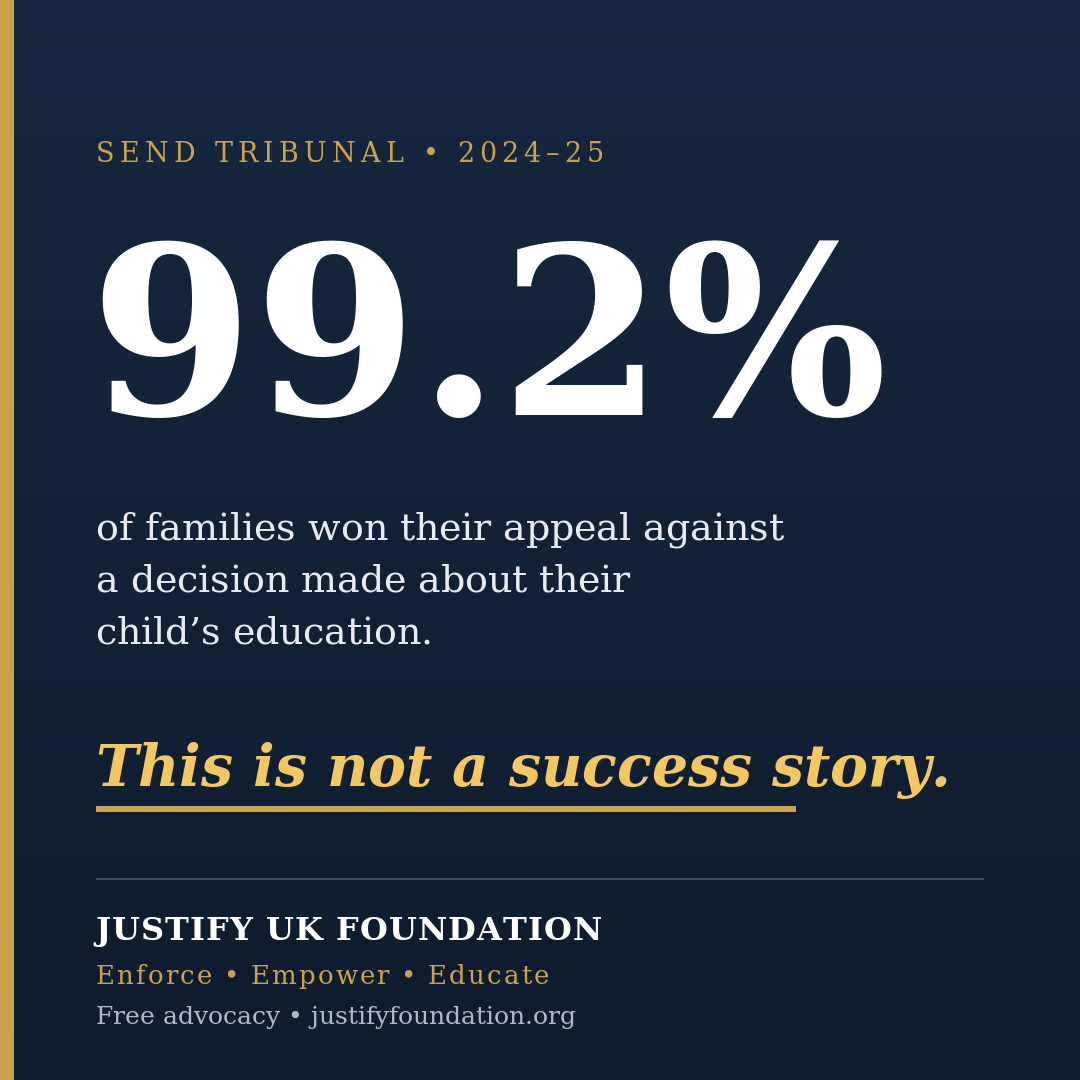
In the 2024-25 academic year, 29,446 families in England appealed to the SEND Tribunal about decisions made on their disabled children's education. These parents won their case 99.2 per cent of the time.
A figure of that kind deserves a moment's reflection. In any contest between citizen and state some margin of official error is to be expected, and a healthy institution learns from its defeats. But when a public body is found to be wrong in more than ninety-nine cases in every hundred, the tribunal has ceased to be a forum where genuine disagreements are settled. It has become a record of decisions that should never have been made.
Justify has supported parents at these hearings. By the time a family reaches a tribunal they have usually spent months or years being told no.
No, your child does not need an assessment.
No, the support in the plan is not really necessary.
No, there is nothing more we can do.
They arrive carrying lever-arch files they have assembled at their kitchen tables at midnight, after work, after caring, and in almost every case the law turns out to have been on their side from the beginning.
None of this is new. A decade ago there were 4,277 appeals a year, and even then parents won 93.9 per cent of them. An institution capable of learning would have treated those defeats as instruction, and changed the way it made decisions. Instead the appeals have grown almost sevenfold, the tribunal's open caseload has reached 15,000, the highest on record, and families wait ever longer for hearings whose outcome is scarcely in doubt. A defeat at tribunal costs a council very little. The waiting costs a family a year of a childhood. Where the consequences of being wrong fall so unevenly, there is no reason to expect the wrong decisions to stop.
Justify has seen this from the inside. In one case we supported, a local authority conceded in the High Court that it had decided wrongly in 86 per cent of its assessments of children with special educational needs in a single year. It is worth pausing over what a concession like that means. A body that errs so consistently has, in effect, adopted error as its method; somewhere along the way it stopped asking the question the law required of it and began asking what it could afford. The concession led to an independent review and seventeen formal recommendations. And it came about only because one family declined to accept, as thousands do each year, the official letter explaining that nothing could be done.
The most important people in this story appear nowhere in these figures. A win rate, however striking, records only the families who found their way to the tribunal. Behind the 29,446 who appealed stand a far greater number who chose to accept the decision. There are thousands of parents worn down by years of asking, parents working and caring in shifts that leave them exhausted. They are the parents who took the official letter at its word, as most of us are inclined to take official letters. Their absence is what makes the whole arrangement affordable. A refusal costs a council nothing until somebody challenges it, and the sums have been done on the reliable assumption that most people never will.
You may have seen that the government is reforming the system. A recent White Paper promises new kinds of support plans and says education, health and care plans will eventually be reserved for children with the most complex needs. Whatever those reforms turn out to mean, they change nothing before September 2030 at the earliest. A child's rights today are exactly what they were last year. If anyone suggests that support is being wound down, or that there is no point asking because the rules are changing, that is wrong, and parents are entitled to insist on what the law says now.
What follows from this is practical. A family that asks for an assessment in writing, keeps a copy of every letter, and watches the deadlines, which can be as short as two months, has already done most of what the families in that 99.2 per cent did. None of it requires a lawyer at the outset, and none of it needs to be faced alone. Justify was founded to stand beside families who cannot afford representation, and we have never charged anyone for our help.
The families in that 99.2 per cent were not lucky, and most were not wealthy. They found out what the law already said about their children, in time to use it. That knowledge should not be the privilege of the few who stumble into it. It belongs to every family, including yours.
If a school or local authority has made a decision about your child that you believe is wrong, we may be able to help. Our support is always free, and you do not need a lawyer to begin. Get in touch via our chat box found in the bottom corner of this page.
Justify is a small charity, and this work is funded entirely by donations. If you would like to help another family reach that hearing room, you can give here.
In December 2023 the High Court found that Hertfordshire County Council had acted unlawfully in failing to complete a child’s education, health and care assessment within the period that Parliament had laid down for it. The case is recorded as R (W) v Hertfordshire County Council [2023] EWHC

3138 (Admin), and Justify supported the family whose challenge brought it there. I want to set out why a dispute that began with one council and one child came to matter far beyond either, because it reveals something about the way these systems yield, slowly and reluctantly, to people who are willing to hold them to their word.
Over 2021 and 2022, Hertfordshire accepted that it had reached an erroneous decision in eighty-six per cent of the relevant special educational needs assessments it carried out. An authority entrusted with the welfare of its most vulnerable children was, on its own admission, getting the answer wrong far more often than it got it right, while the families on the receiving end were largely expected to treat those decisions as settled and final.
Most of them did. That acquiescence, drawn from people who had every right to refuse it, is the deeper failure here, and the one least likely ever to reach a courtroom. The law furnished every one of those parents with grounds to object, yet grounds are worth little to someone who does not know that they hold them, cannot afford a solicitor to press them, and has been told, in the measured and seemingly unanswerable language of administration, that the matter is now closed.
The court went considerably further than recording the breach. It affirmed that the duty to complete an assessment within twenty weeks binds an authority absolutely, that an appeal to best endeavours is no answer to it, and that time begins to run from the day a parent makes the request, whatever later date the authority might prefer to acknowledge. The case then settled on terms of real consequence. Hertfordshire agreed to commission an independent review of the way it reaches these decisions. That review, published in July 2024, ran to ninety-six pages and made seventeen formal recommendations; the council set out a plan to implement them, reported its progress to its own scrutiny committee, and undertook to examine its performance data each month. A single family’s refusal to treat an unlawful decision as the last word had become a monitored programme of reform touching every child the authority assesses.
The significance of this reaches further still. A barrister who examined the case afterwards described it as a demonstration of what strategic, policy-based judicial review can accomplish, and as work that helps to secure good governance under the rule of law. It has since been cited in other proceedings; when Cambridgeshire County Council was challenged over a similar delay in 2026, the Hertfordshire judgment formed part of the ground on which the argument stood. This is what I mean when I say that a single case can prove something. Its value outlasts the dispute it settles, enduring as an instrument that other families, and the lawyers who act for them, can take up in their turn.
Meanwhile the underlying need continues to grow. Across England, authorities are declining to assess a rising proportion of the children brought to them. A few years ago they refused around a fifth of requests; by 2023 the figure had climbed towards a third; and in 2024 little more than two thirds of requests were agreed at all. A family making the request is markedly more likely to be turned away than a school or a clinician making the same one, and behind every refusal stands a parent weighing whether they possess the knowledge, the means and the endurance to contest it.
That weighing is where Justify does its work. We help families to understand what has actually happened to them and whether the decision can properly be challenged; we stand beside them in rooms that are arranged to make them feel small and alone; and where the law can be made to compel an account, we use it, as we used it in Hertfordshire. We are a small charity, sustained by volunteers, and we carry this work without the legal aid or the professional fees that place it beyond the reach of the families who most need it.
The Hertfordshire case cost time, persistence and money, and in the end it changed the way an entire authority treats thousands of children. Every family who comes to us has first been told that the decision is final; what we offer is the means to discover whether that is true. A gift of any size helps us stand beside the next family, and the next child, before an unlawful decision is allowed to become the last word.
To support Justify’s work, donate here. Registered charity 1188873.
If your family is facing an unlawful or unfair decision and you need advice, contact us.
Nick Whiteley, Founder, Justify UK Foundation
When my son's school excluded him permanently, I was not looking for a cause as much as I was looking for answers.

He has ADHD. For a time, he attended a school whose headteacher had formed the view that the way to address this was through punishment. The reasoning, if one can call it that, was that sufficiently consistent consequences would alter the behaviour. What it actually did was compound a child's distress and confirm, day by day, that the institution charged with his education regarded him as a problem to be managed rather than a person to be taught.
When that approach failed, as it was always going to, the school permanently excluded him. The decision arrived as the conclusion of a proper process.
I had no immediate reason to believe otherwise. I am not a lawyer. I had no particular knowledge of education law or the rights of excluded children. I had only a father's conviction that something had gone wrong, and enough determination to start finding out what.
What I found was that the exclusion was unlawful. The process had not been followed correctly. The decision did not meet the standard the law required and the school maintained otherwise. Challenging it cost a great deal, financially and personally. While the law ultimately gave me an account of the wrong, and a measure of accountability, it could not repair what had happened to my son. This distinction matters a lot, and it has shaped everything I have tried to do since.
Such a challenging experience for my family alerted me to the fact that many similar decisions had been imposed on other families and, likely feeling helpless and voiceless, they had accepted them, because they did not know that acceptance was a choice.
I encountered people who had tried to challenge what had been done to them and given up, because the process felt deliberately impenetrable. The assumption, again and again, was that the authority's word was the last word.
Yet it is not the last word.
But that’s only useful information if someone can help you understand why, and what to do about it.
I qualified myself to help. First a paralegal certificate, then a postgraduate diploma in law and a Bachelor of Laws degree. These were tools I acquired in response to a specific problem: people were being failed by public bodies, the law gave them grounds to challenge those failures, and the gap between those two facts was the gap in which Justify needed to exist.
Since founding the charity in 2020, I have worked in court as a McKenzie Friend, a non-legal supporter permitted to assist those who cannot afford representation, and as a lay advocate, supported clients across a wide range of legal areas, and undertaken the investigative research that these cases require. Justify's legal work has even reached the High Court. In one case, a local authority admitted making erroneous decisions in 86 percent of relevant assessments over a two-year period. The legal action that exposed this resulted in an independent review that produced seventeen formal recommendations and a publicly monitored improvement programme. A barrister's analysis of that case described it as an example of what strategic, policy-based judicial review can do to guarantee good governance under the rule of law.
I take some satisfaction in that. But the work is demanding and frequently distressing. The systems involved are large and slow and have learned that most people will not challenge, and even if they do, they won’t or cannot persist. The families who come to Justify have almost always been through a great deal before they arrive.
What Justify provides, beyond the legal support, is presence: the knowledge that someone is standing alongside you in a process that otherwise seems designed to make you feel alone. That, perhaps more than any legal outcome, is what people tell us made a difference. One client, whose case ran across family and criminal law simultaneously, chose to continue with Justify's support even after legal aid was finally granted to her, because of the trust that had been established. Another said, with a directness I have not forgotten, that without this support she did not think she would still be alive.
Those things do not appear in case reports or policy documents of course, but they are the reason the work continues.
Justice is the condition under which people can believe that what is done to them by the institutions of their society will be answerable to some standard beyond those institutions' own convenience. When that condition breaks down, something more than a legal right is lost.
Justify exists to restore it, family by family and case by case.
If you would like to support this work, you can donate at justifyfoundation.org. Every contribution goes directly to legal advocacy and investigative support for families who have nowhere else to turn.
Justify UK Foundation | Registered charity 1188873
Tell us what has happened. We’ll consider whether we can help.